
Atascosa County Sex Offender Checks
The Texas Public Sex Offender Registry, maintained by the Texas Department of Public Safety Crime Records Division, is the main public lookup. Atascosa County does not publish a separate local registry database. The Sheriff’s Office registers and verifies people who report through its jurisdiction, but its appointment counter is not a public-search counter.
Choose a search mode that fits what is known. A full name helps distinguish people, while county, city, ZIP, and address searches reveal geographic results. Read the registering agency, reported address status, photograph, and last update together. A map pin alone is not enough because geocoding can place an incomplete or unusual address inaccurately.
The official DPS registry interface shows the statewide starting point:
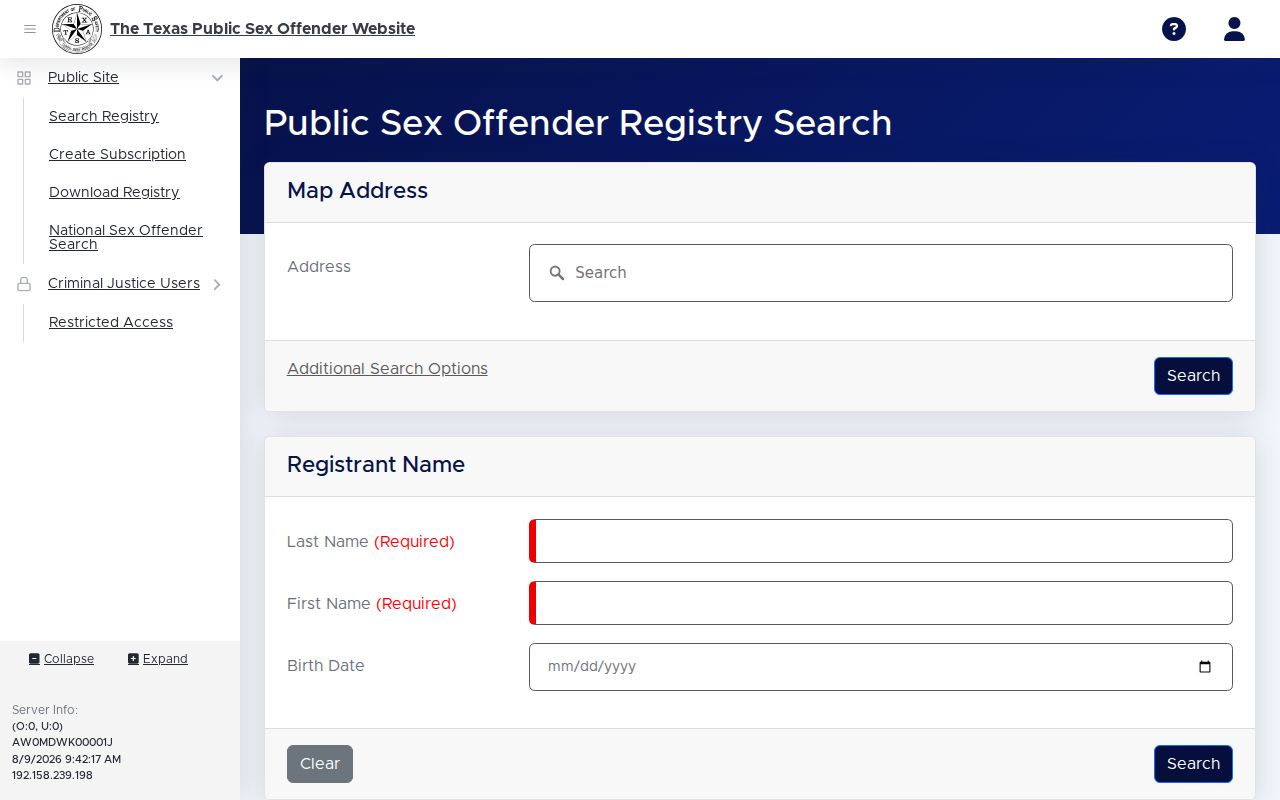
Its multiple search modes let an Atascosa County resident move from a broad county list to a more exact name or address query.
Appointment-Only Registration on Campbell Avenue
The Atascosa County Sheriff’s Office performs registration at 1108 Campbell Avenue in Jourdanton. Appointments are available Tuesday through Thursday from 9:00 to 11:00 a.m. and 1:00 to 3:00 p.m. Call 830-769-3434 extension 2233. Registration, scheduled verification, and changes of status occur in person.
Atascosa County Sheriff’s Office
1108 Campbell Avenue
Jourdanton, TX 78026
830-769-3434 ext. 2233
Tuesday-Thursday, 9-11 a.m. and 1-3 p.m.
This channel is for registrants meeting legal duties and for agency verification. Members of the public should search DPS, then contact the registering agency if a result appears wrong or a person seems noncompliant. Call 911 only for an immediate emergency.
Texas Public Sex Offender Registry Searches
DPS provides name and geographic search modes. Accept the conditions of use before searching, and supply enough information to avoid associating a record with the wrong person.
- Open the Texas registry and review its lawful-use terms.
- Choose name, address, or geographic criteria. Select Atascosa for a county-focused list.
- Compare the result list by name, photograph, city, reported address, and registering agency.
- Open the profile and read the offense, status, and latest verification or update fields before drawing conclusions.
| Field | Type | Required | Use |
|---|---|---|---|
| Last Name | Text | Depends on mode | Name search; pair it with other identifiers. |
| First Name | Text | Narrowing | Helps separate similar surnames. |
| Address | Text | Address mode | Runs a proximity or map-based search. |
| City / County / ZIP | Text or select | Optional | Localizes results to Atascosa communities. |
| Radius | Select | Address mode | Available values can change with the live interface. |
| Map / List | View control | No | Changes how geographic results are presented. |
Map Results and Unmapped Atascosa Addresses
A plotted result reflects the address and geocoding information available to DPS. It is not a live location tracker. A recent move may not yet appear, and a rural route, incomplete address, or mapping mismatch can leave a listing unmapped or positioned imprecisely. Search both map and list views, then compare the profile’s written address and registering agency.
When location awareness crosses state lines, the U.S. Department of Justice’s National Sex Offender Public Website searches participating jurisdictions. The national system supplements rather than replaces the Texas profile.
The official NSOPW search page illustrates that broader layer:
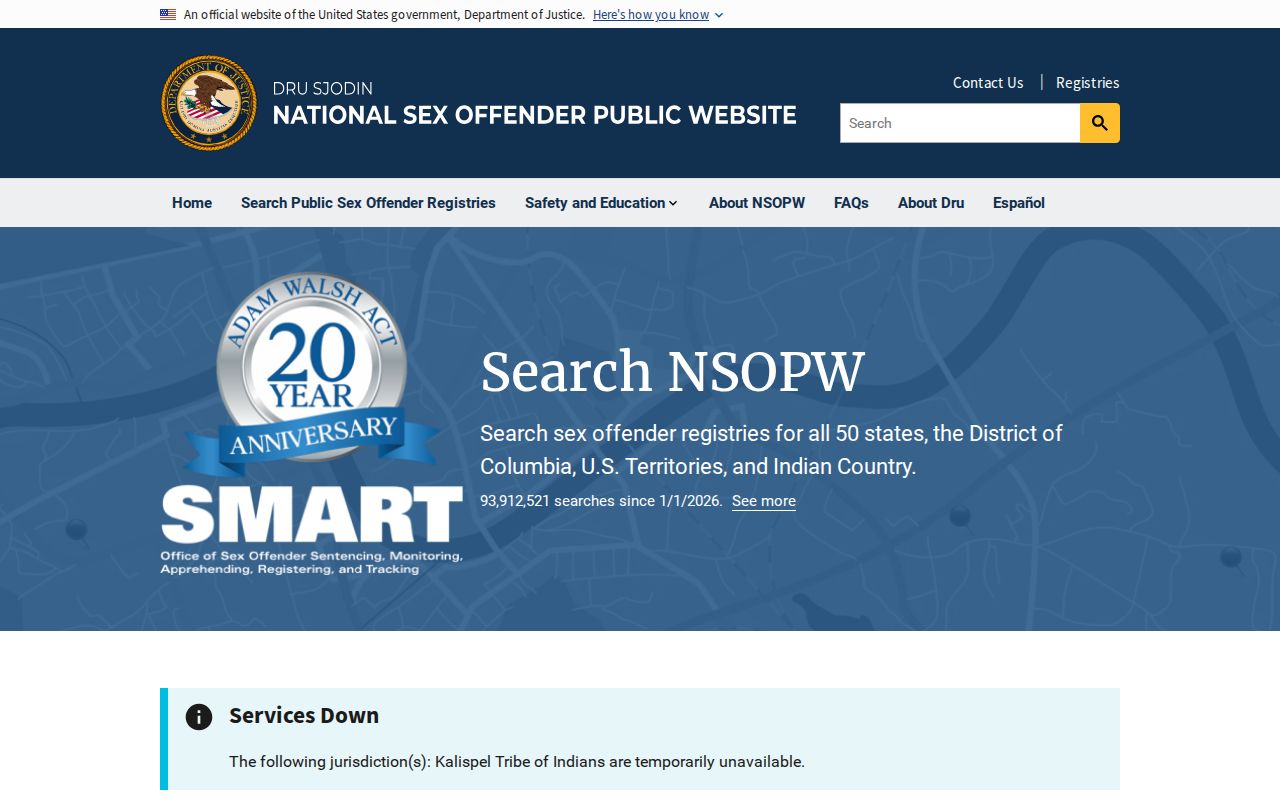
Use it for a person or address connected to more than one state, then return to DPS or the listed agency for Texas details.
Note: A missing map pin does not establish that no registrant is associated with an area.
Registry Profiles: What They Show
A public profile combines identity, registration, offense, and verification fields. Availability varies by record, and blank fields should not be filled by assumption.
| Name & Aliases | Registered name and publicly available aliases used to distinguish the person. |
|---|---|
| Photo & Description | Photograph, age or date-of-birth display, sex, race, and physical descriptors. |
| Reported Address | Published residence information and status as permitted by Texas law. |
| Offense | Description, statute, adjudication or conviction date, and jurisdiction. |
| Registration Duty | Status and category information, which must be read under Texas rules rather than assumed from a federal tier. |
| Verification | Registering agency, compliance status, and last verification or update when displayed. |
Public fields may also include scars, marks, tattoos, vehicle information, and school or work data where the statute permits. Phone numbers, Social Security numbers, driver-license details, online identifiers, and protected victim information are not a general public profile inventory.
What Texas Keeps Off Public Profiles
Public access does not make an agency’s entire registration file open. Government Code Chapter 411 controls disclosure, and other confidentiality rules protect identifiers and victim information. The public view is designed for safety awareness, not unrestricted access to every item supplied during registration.
The current Texas Government Code Chapter 411 is the primary statutory source for dissemination and registration provisions:
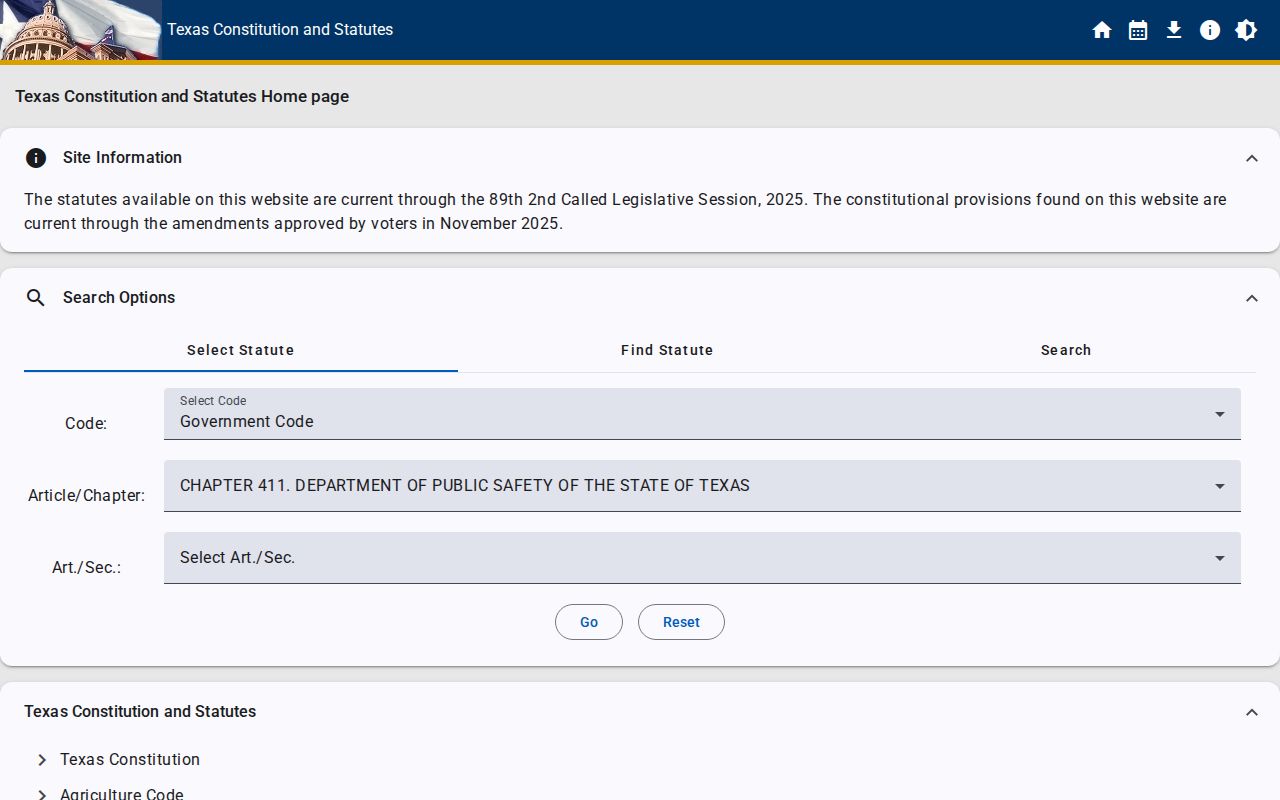
Reading the statute matters when a profile label, duration, or disclosure question requires more precision than the public result supplies.
Registration Levels and Duties in Texas
Texas does not reduce every public listing to a simple low, medium, or high tier. Duration and verification duties depend on the reportable conviction or adjudication and statutory category. A displayed label should never be used to invent a term or schedule.
| Texas concept | General duration | Verification |
|---|---|---|
| Ten-year registration | Measured under statute after release or discharge for listed offenses not assigned lifetime duty. | Follow the schedule assigned by DPS and the registering agency. |
| Lifetime registration | Applies to enumerated serious offenses and certain repeat or combined circumstances. | Frequency depends on the offense and statutory category. |
| Specified violent or repeat categories | Duration follows the governing offense provision. | Verification can be more frequent than the ordinary schedule. |
For an exact answer, use the current statutory provisions and the registering agency’s instructions. Federal SORNA terminology is not a safe substitute for Texas law.
Reporting a Wrong Address or Noncompliance
First check whether the profile identifies the Atascosa County Sheriff or another police department as the registering agency. Report a suspected wrong address or missed duty to that agency and describe the specific profile and discrepancy. Do not confront the person, enter private property, or circulate an unverified accusation.
Address data may trail a reported move, and a map error can differ from registration noncompliance. The agency can compare public information with its protected working file. For an Atascosa County registration question, extension 2233 is the direct local route.
City Resident or County Resident
The registering agency shown on a Texas profile is a practical routing clue. An address inside a city police jurisdiction may be handled through that police chief’s registration authority, while an address under county jurisdiction routes through the Sheriff. The public registry remains the same DPS system in either case. Atascosa County residents should not assume that proximity to Pleasanton, Jourdanton, or Poteet identifies the responsible office because city limits and mailing addresses are not identical.
Check the profile’s agency field before calling. If the Atascosa County Sheriff is listed, use extension 2233 during the published appointment blocks. If a city department is listed, contact that department’s official line. A move can shift responsibility from one registering authority to another, which helps explain why an older profile and a current address search may seem inconsistent while updates are processed.
Registration personnel can confirm routing and receive a factual noncompliance report, but protected file contents do not become public merely because someone asks at the counter.
Using Registry Information Lawfully
Registry information supports personal, family, and community safety planning. It does not authorize surveillance, threats, exclusion beyond what law allows, or a claim that a listed person has committed new misconduct. Verify a record with DPS or the registering agency before relying on it.
Misuse warning: Texas Government Code Chapter 411 does not permit registry information to be used to injure, harass, threaten, intimidate, trespass, discriminate unlawfully, or commit a crime against a registrant or the registrant’s household.
The Texas expunction statute is separate from sex-offender registration duties and should not be read as an automatic way to remove a registry listing:
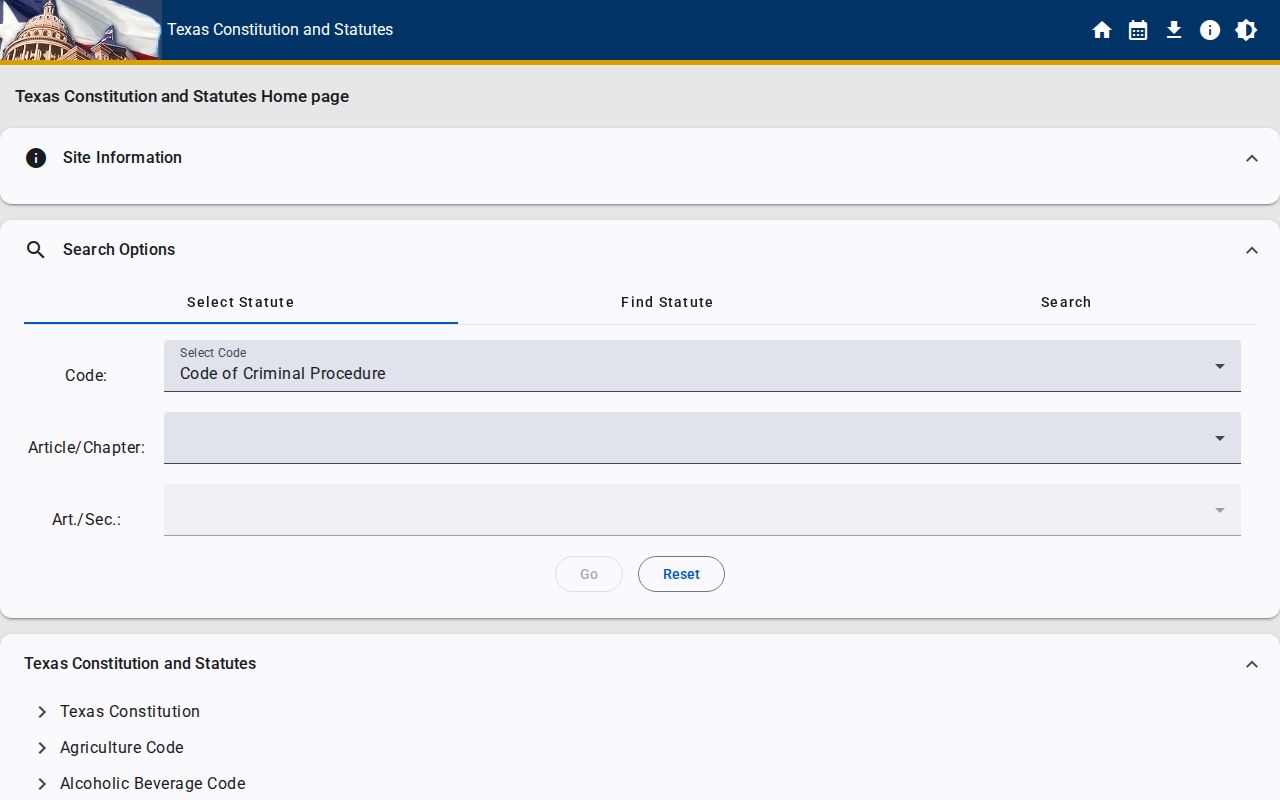
Whether a duty ends or data changes depends on the governing registration law, the underlying case, and a valid legal order, not merely on a request to hide a public profile.